
How to Store Research Peptides Properly

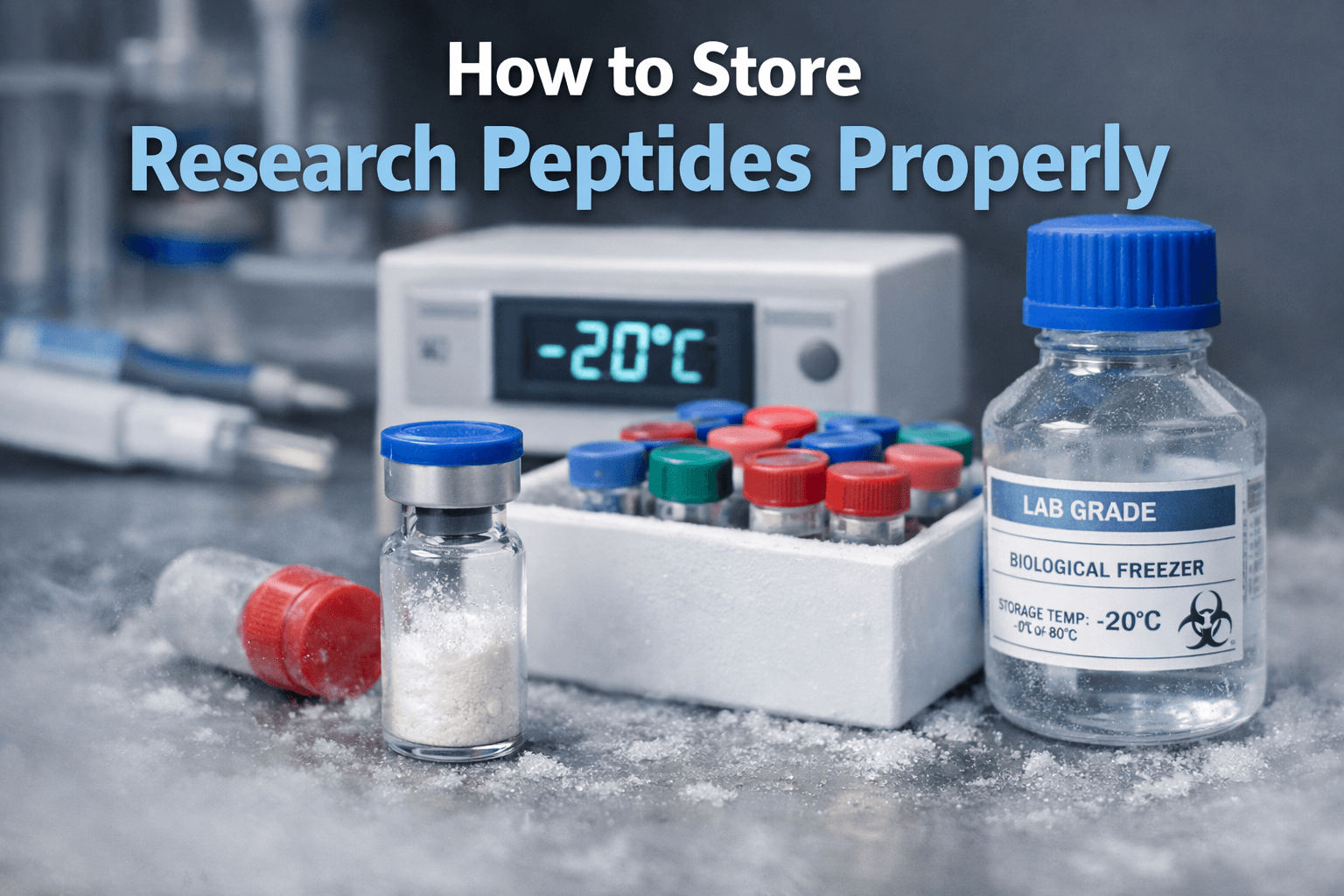
If you’ve ever lost a batch of peptides to improper storage, you already know how frustrating and expensive that mistake can be.
Whether you’re running a lab, working in pharmaceutical research, or studying peptide synthesis, one truth remains constant: how you store your peptides matters just as much as the peptides themselves. Even the highest-quality research peptides can degrade, oxidize, or lose potency if they’re not handled correctly.
This guide walks you through everything you need to know about storing research peptides properly, from temperature and light exposure to reconstitution and long-term preservation.
Why Proper Peptide Storage Matters
Peptides are short chains of amino acids. That sounds simple, but their structure is surprisingly fragile. Environmental factors like heat, moisture, light, and oxygen can break peptide bonds, trigger oxidation, or cause aggregation — all of which compromise your research results.
The consequences aren’t just about wasted money. Degraded peptides can produce misleading data, throw off assay results, or render an entire experiment invalid. When you’re working on research that depends on precision, storage is a non-negotiable part of your protocol.
Key Factors That Affect Peptide Stability
Before diving into storage recommendations, it helps to understand what actually threatens peptide stability:
Temperature: Peptides are heat-sensitive. Higher temperatures speed up degradation reactions, especially hydrolysis (breaking of peptide bonds by water) and deamidation (a chemical change affecting asparagine and glutamine residues).
Moisture: Water is a peptide’s worst enemy in storage. Aqueous environments accelerate nearly every degradation pathway. Lyophilized (freeze-dried) peptides fare far better over time than those in solution.
Light (UV exposure): Certain amino acids, particularly tryptophan, tyrosine, and phenylalanine, are photosensitive. UV light can trigger oxidation and irreversible structural changes.
Oxygen: Cysteine and methionine residues are especially prone to oxidation. Exposure to air during storage can quietly degrade a peptide long before you notice.
pH: For peptides in solution, pH plays a significant role. Most peptides are most stable at slightly acidic pH levels (around 5–6).
How to Store Lyophilized (Dry) Peptides
Lyophilized peptides are the easiest to store and the most stable form you’ll work with. Here’s the standard best practice:
Short-Term Storage (Days to Weeks)
- Store at −20°C in a standard laboratory freezer
- Keep peptides in their original sealed vials
- Use a desiccant or store in a dry environment to prevent moisture absorption
- Avoid repeated freeze-thaw cycles
Long-Term Storage (Months to Years)
- Store at −80°C for optimal stability
- This is especially important for peptides containing cysteine, methionine, tryptophan, or asparagine
- Flush the vial with inert gas (argon or nitrogen) before sealing if you plan on long-term storage
- Store in the dark or use amber vials to prevent light degradation
Pro tip: When you remove a peptide from the freezer, let the sealed vial equilibrate to room temperature before opening. This prevents condensation from forming on the peptide powder, a common mistake that introduces moisture and shortens peptide lifespan.
How to Store Peptides in Solution (Reconstituted)
Once a peptide is dissolved, the clock starts ticking. Solutions are significantly less stable than lyophilized forms, and the storage rules tighten.
Short-Term Storage (Up to 1 Week)
- Store at 4°C (standard refrigerator temperature)
- Keep in tightly sealed vials or microtubes
- Avoid exposure to light, wrap tubes in aluminum foil if needed
- Keep pH slightly acidic (5–6) where possible
Medium-Term Storage (Weeks to a Few Months)
- Aliquot solutions into single-use volumes before freezing
- Store at −20°C or −80°C
- This is critical, aliquoting prevents repeated freeze-thaw cycles that degrade peptides quickly
Solvent Choice Matters
- Dissolve hydrophilic peptides in sterile water or aqueous buffer
- Use organic solvents like DMSO or acetonitrile for hydrophobic peptides that don’t dissolve well in water
- Avoid acidic or basic solvents unless specifically required, they can catalyze hydrolysis
How to Handle Peptide Vials Safely
Even great storage conditions can be undermined by poor handling. Here are some practical habits that protect peptide integrity:
Let vials warm up before opening. As mentioned above, temperature equilibration before opening prevents condensation. Fifteen minutes at room temperature is usually enough for small vials.
Use clean, dry equipment. Contaminated spatulas, pipettes, or reconstitution solvents can introduce nucleases, proteases, or microbial contamination that destroys peptides fast.
Minimize time at room temperature. Don’t leave peptides sitting on the bench while you set up your experiment. Work quickly, return vials to cold storage promptly.
Label everything clearly. Include the peptide name, concentration, date of reconstitution, solvent used, and any relevant lot numbers. Research moves fast, and unlabeled vials become liabilities.
Track freeze-thaw cycles. Mark each cycle on the vial label. Most peptides tolerate 3–5 freeze-thaw cycles before significant degradation, beyond that, you’re risking compromised results.
Special Considerations for Specific Peptide Types
Not all peptides are created equal when it comes to storage. Some require extra precautions:
Cysteine-Containing Peptides
These are the most challenging to store. Cysteine’s thiol group oxidizes easily, forming disulfide bonds that alter the peptide’s structure and activity. Store these under inert gas (argon/nitrogen), add reducing agents like DTT or TCEP to solutions, and keep at −80°C whenever possible.
Phosphopeptides
Phosphate groups can be labile under acidic or high-temperature conditions. Store lyophilized at −80°C, and avoid prolonged exposure to acidic pH once reconstituted.
Methionine-Containing Peptides
Like cysteine, methionine is oxidation-prone. Purging vials with inert gas before sealing adds meaningful protection for long-term storage.
Hydrophobic Peptides
These often aggregate in aqueous solution. DMSO is frequently used for initial dissolution, after which the solution can be diluted into buffer. Avoid freeze-thaw in aqueous solution if possible, lyophilized storage is strongly preferred.
Common Peptide Storage Mistakes (and How to Avoid Them)
Mistake #1: Opening a cold vial directly from the freezer. The fix: Always let vials equilibrate to room temperature before opening.
Mistake #2: Storing reconstituted peptides in one large vial. The fix: Aliquot into single-use volumes immediately after reconstitution.
Mistake #3: Leaving peptides in solution for weeks. The fix: Lyophilized storage is always superior for anything beyond a few days.
Mistake #4: Storing next to strong-smelling reagents or acids. The fix: Volatile compounds in a freezer can contaminate peptide vials over time. Keep peptides in sealed bags or boxes.
Mistake #5: Ignoring peptide-specific stability data. The fix: Check the technical data sheet provided by your supplier. Many will note specific storage requirements based on amino acid composition.
Peptide Storage Summary Table
| Storage Condition | Form | Temperature | Duration |
| Short-term dry | Lyophilized | −20°C | Weeks to months |
| Long-term dry | Lyophilized | −80°C | 1–2 years or more |
| Short-term in solution | Reconstituted | 4°C | Up to 1 week |
| Long-term in solution | Aliquoted, frozen | −20°C to −80°C | Weeks to months |
Final Thoughts
Proper peptide storage isn’t complicated, but it does require consistency and attention to detail. The core principles keep it cold, keep it dry, keep it dark, and minimize handling, apply to virtually every peptide you’ll work with.
Investing a little extra care in your storage protocol pays off enormously in data reliability, reduced waste, and research reproducibility. In a field where results need to stand up to scrutiny, your storage practices are part of your scientific rigor.
When in doubt, default to the most conservative option: lyophilized, sealed under inert gas, stored at −80°C, and aliquoted before freezing. Your future self running the assay three months from now, will thank you.
