
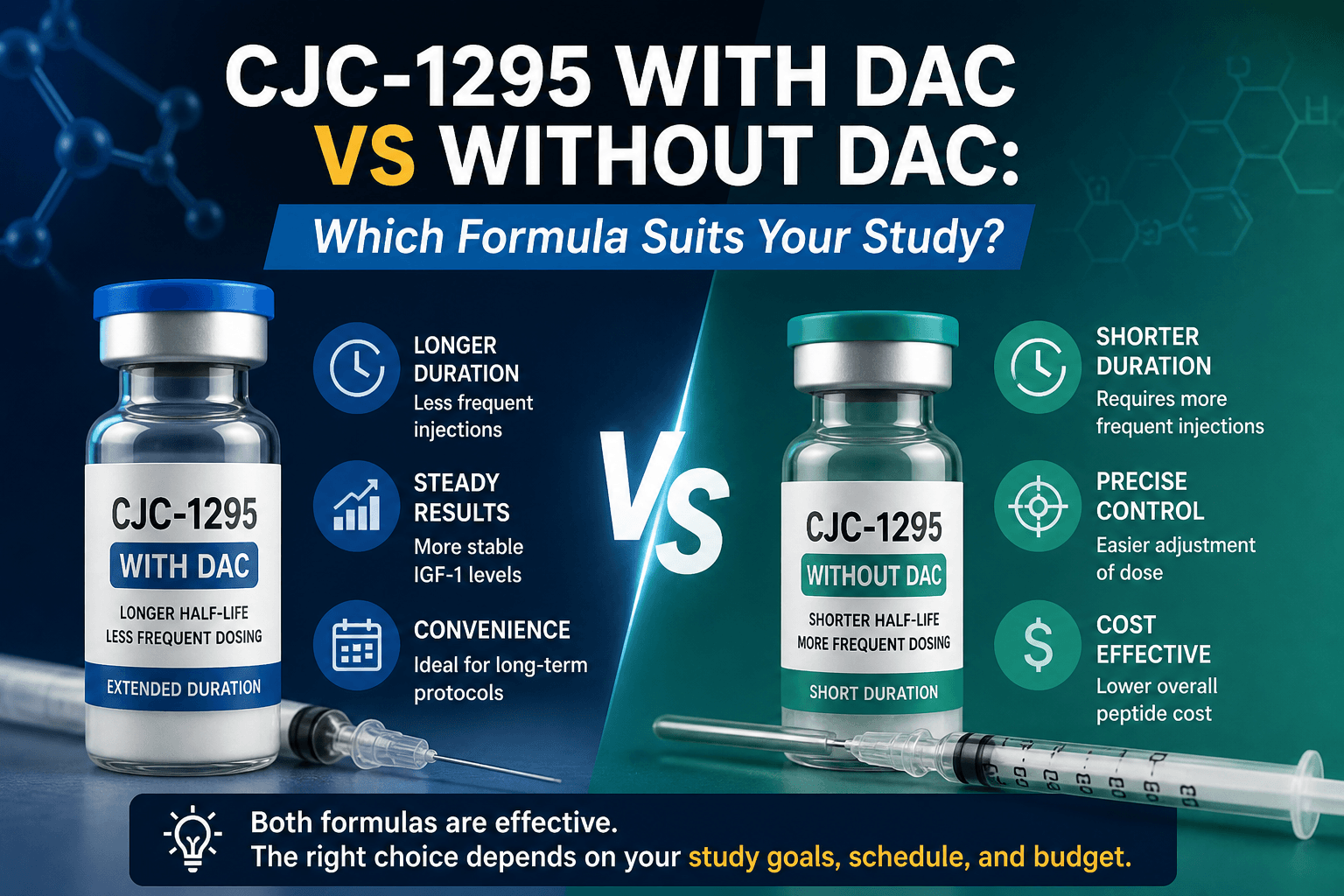
CJC-1295 With DAC vs Without DAC: Which Formula Suits Your Study?

If you’ve spent any time looking into growth hormone research peptides, you’ve probably hit this exact wall:
“Should I use CJC-1295 with DAC or without DAC?”
It sounds like a simple question. But the answer changes your entire research protocol, dosing schedule, GH release pattern, stacking strategy, and the type of data you’ll collect.
Despite sharing almost the same name, these two peptides behave very differently inside a biological system. One lasts up to 8 days from a single injection. The other clears in about 30 minutes. That one difference has a cascade of consequences for any study design.
This guide breaks it all down, clearly, practically, and without the fluff.
Research Disclaimer: CJC-1295 (with or without DAC) is a research peptide for laboratory and academic use only. It is not approved for human consumption or clinical application. All content here is for educational purposes.
What Is CJC-1295 and Why Does It Exist in Two Forms?
Before comparing the two versions, it helps to understand why CJC-1295 was created in the first place.
The hypothalamus naturally produces Growth Hormone-Releasing Hormone (GHRH), a peptide that signals the pituitary gland to release growth hormone (GH). The problem? Native GHRH has a half-life of just 5 to 7 minutes in the bloodstream. Enzymes called dipeptidyl peptidases (DPP-IV) degrade it almost immediately, making it nearly useless for sustained research.
CJC-1295 was engineered to fix that. It’s a modified 29-amino acid fragment of GHRH (sometimes called GHRH 1-29) with four amino acid substitutions that make it far more resistant to enzymatic breakdown. Even without any additional modifications, it already lasts much longer than native GHRH.
Then, researchers went a step further, they developed two distinct versions:
- CJC-1295 with DAC — the long-acting version, lasting 6–8 days
- CJC-1295 without DAC (also called Mod GRF 1-29 or Modified GRF 1-29) — the short-acting version, lasting ~30 minutes
Same base peptide. Very different pharmacokinetics. Very different research applications.
The Core Difference: What Does DAC Actually Do?
DAC stands for Drug Affinity Complex, a reactive chemical group added to the end of the CJC-1295 peptide chain.
Its job is straightforward: when injected, the DAC moiety seeks out and covalently bonds with serum albumin, the most abundant protein in the bloodstream. Albumin has a half-life of roughly 20 days. Once CJC-1295 latches onto it, the peptide essentially hitches a ride on albumin’s long lifespan.
The result? Instead of being degraded within minutes, CJC-1295 with DAC remains active in circulation for 6 to 14 days from a single injection. It continuously stimulates the GHRH receptor throughout that window, creating a sustained, rather than pulsatile, elevation of growth hormone.
Without DAC, none of that albumin-binding happens. The peptide circulates freely, does its job for about 30 minutes, and gets cleared. What you get instead is a sharp, clean pulse of GH stimulation, and then it’s gone.
That difference, sustained stimulation vs. pulsatile stimulation, is the crux of every practical consideration between these two compounds.
CJC-1295 With DAC vs Without DAC: Quick Comparison
| Feature | CJC-1295 With DAC | CJC-1295 Without DAC (Mod GRF 1-29) |
| Half-Life | 6–8 days (up to 14) | ~30 minutes |
| Also Called | CJC-1295 DAC | Mod GRF 1-29, Modified GRF 1-29 |
| GH Release Pattern | Sustained, non-pulsatile (“GH bleed”) | Sharp pulsatile spikes |
| Mimics Natural GH Secretion? | No — creates a continuous baseline | Yes — matches natural pulsatile rhythm |
| Dosing Frequency | 1–2x per week | 2–3x per day |
| Albumin Binding | Yes | No |
| Best Stacking Partner | GHRPs (with reduced acute synergy) | GHRPs like Ipamorelin (gold standard stack) |
| Receptor Desensitization Risk | Higher (chronic stimulation) | Lower (pulsatile pattern preserved) |
| Research Convenience | High | Moderate |
| Best For | Sustained GH/IGF-1 elevation studies | Pulsatile GH dynamics, combination protocols |
Half-Life Deep Dive: Why It Matters More Than You Think
Half-life isn’t just a pharmacology metric; it shapes your entire study design.
CJC-1295 With DAC: The Long Game
A single injection of CJC-1295 with DAC binds to albumin within minutes of entering the bloodstream. From there, it delivers a slow, steady stream of GHRH receptor stimulation over the following week-plus.
A landmark study published in the Journal of Clinical Endocrinology & Metabolism (Teichman et al., 2006) showed that a single injection of CJC-1295 with DAC elevated GH levels by 2–10x above baseline and kept IGF-1 elevated for up to 6 days post-injection. Follow-up work confirmed sustained IGF-1 elevations lasting up to 14 days in some subjects.
What this creates in a research context is what’s sometimes called a “GH bleed”, a constant background elevation of growth hormone that never fully returns to baseline between doses. For studies examining the downstream effects of chronically elevated GH (think: IGF-1 responses, tissue-level changes, anti-aging markers), this is genuinely useful.
But there’s a trade-off: this sustained stimulation pattern is not physiological. The body doesn’t naturally maintain elevated GH around the clock. That’s an important variable to factor into study design.
CJC-1295 Without DAC: The Pulse
Without the albumin anchor, Mod GRF 1-29 gets cleared in roughly 30 minutes. Each injection triggers a brief but pronounced burst of GHRH receptor activity — a clean pulse of GH secretion that resolves within 2–3 hours and then drops back to baseline.
This is actually closer to how the body naturally works. Human GH secretion is inherently pulsatile — sharp spikes and troughs, with the biggest pulse typically occurring during deep sleep. The no-DAC version replicates this rhythm rather than overriding it, which matters a great deal in studies that are trying to model or measure physiological GH dynamics.
The short half-life also means researchers have precise timing control over when GH pulses occur, a significant methodological advantage in controlled studies.
Growth Hormone Release Patterns: Pulsatile vs. Sustained
This section is worth reading carefully, because it’s where most researchers make their decision.
The human body regulates GH through a push-pull system:
- GHRH (secreted by the hypothalamus) stimulates GH release
- Somatostatin inhibits it
These two hormones alternate in pulses, creating the sharp peaks and troughs that define normal GH secretion. When you introduce a GHRH analog into this system, what you’re doing depends entirely on how long that analog stays active.
CJC-1295 With DAC essentially overrides the somatostatin rhythm by maintaining continuous GHRH receptor stimulation. GH levels rise and stay elevated. The pulses don’t disappear entirely, research shows pulse frequency and magnitude are partly preserved, but they ride on top of a significantly elevated baseline. Think of it as adding a permanent floor to the GH curve.
CJC-1295 Without DAC works within the natural system rather than overriding it. The 30-minute window is long enough to trigger a meaningful GH pulse, and then the peptide clears before somatostatin-driven feedback can blunt the next natural pulse. This preserves the physiological rhythm and reduces the risk of pituitary receptor desensitization — a real concern with chronic, non-pulsatile GHRH stimulation.
For researchers who care about reproducing or studying natural GH dynamics, the no-DAC version is the more accurate tool.
Dosing Protocols in Research Settings
The following reflects dosing protocols observed in published preclinical and early-phase research. This is not medical advice.
CJC-1295 With DAC Dosing
Because of its extended half-life, the DAC version only needs to be administered once or twice per week in most research protocols. This simplicity reduces experimental noise from injection frequency and is a genuine operational advantage in longer-term studies.
- Frequency: 1–2x weekly
- Route: Subcutaneous injection (most common in animal models)
- Onset: GH elevation builds gradually over the first 24–48 hours
- Key consideration: Steady-state GH levels accumulate with repeated dosing — factor this into baseline measurements
CJC-1295 Without DAC (Mod GRF 1-29) Dosing
The no-DAC version requires more frequent administration — typically 2–3 times daily — because each injection only lasts ~30 minutes.
- Frequency: 2–3x daily
- Route: Subcutaneous injection
- Timing: Results are highly dependent on when injections occur relative to endogenous GH pulsatility (fasting states, sleep cycles in animal models)
- Key consideration: Injection timing becomes a critical experimental variable — control it carefully
Stacking With GHRPs: Where No-DAC Dominates
One of the most studied protocols in GHRH research is pairing CJC-1295 with a growth hormone-releasing peptide (GHRP), most commonly Ipamorelin.
Here’s why this combination is so powerful: CJC-1295 and GHRPs work through entirely different receptor pathways. CJC-1295 stimulates the GHRH receptor. Ipamorelin activates the ghrelin receptor (GHSR). When timed together in the same injection, they hit two separate inputs simultaneously — and the GH response is synergistic, not just additive.
In combination research with Ipamorelin, the no-DAC form is preferred because it creates physiologically relevant pulsatile GH release rather than a continuous elevation. The timed co-injection can produce GH spikes significantly greater than either peptide alone.
The no-DAC + Ipamorelin stack is considered the gold standard for GH secretagogue research and for good reason. Both compounds are timed to work together in the same acute window, amplifying the same GH pulse.
CJC-1295 with DAC also stacks with GHRPs, but the dynamic is different. The DAC version raises baseline GH levels continuously but does not produce the same acute pulse amplification because the GH environment is already chronically elevated, and the pulsatile dynamic is partly blunted.
Bottom line for stacking studies:
- Want maximum acute GH pulse response → Mod GRF 1-29 + Ipamorelin
- Want sustained elevated GH baseline + GHRP on top → CJC-1295 DAC + GHRP
Which Formula Actually Suits Your Study?
Here’s the practical decision framework:
Go With CJC-1295 With DAC If:
- Your study needs sustained, stable GH and IGF-1 elevation over multiple days.
- You want minimal injection frequency to reduce experimental variables.
- You’re studying the downstream effects of chronically elevated GH, tissue responses, IGF-1 kinetics, and anti-aging markers.
- Your protocol runs over weeks or months, and simpler dosing matters.
Go With CJC-1295 Without DAC (Mod GRF 1-29) If:
- You need pulsatile GH secretion that mirrors endogenous physiology.
- You’re studying acute GH responses to specific stimuli.
- You plan to co-administer with Ipamorelin or another GHRP for synergistic GH spikes.
- Your protocol needs precise timing control over GH release windows.
- You want to minimize receptor desensitization risk in long-running studies.
A Note on Receptor Desensitization
This often gets overlooked, but it matters, especially in longer study designs.
A short half-life like Mod GRF 1-29’s allows it to create a strong, sharp pulse of GH that closely mirrors the body’s natural rhythm, after which it’s quickly cleared, which helps prevent pituitary desensitization and maintains the integrity of natural feedback loops.
With CJC-1295 DAC, the pituitary is being continuously stimulated for days at a time. Over-extended protocols, this chronic receptor stimulation could theoretically reduce receptor sensitivity, an important variable to account for if your study runs for weeks.
No-DAC’s pulsatile pattern gives the GHRH receptor time to reset between injections, which is why it’s generally considered the lower-risk option for longer research windows.
Where to Source CJC-1295 for Research
Whatever version you need, purity matters enormously. Impure or mislabeled peptides introduce variables that can invalidate your data, or worse, produce misleading results that compound errors down the line.
At Cloud Pharmacy Care, we carry both CJC-1295 with DAC and CJC-1295 without DAC, each:
- Lab-tested for purity and potency before it ships
- Backed by a Certificate of Analysis (COA) for every batch
- Packaged for secure and discreet delivery
- Sourced specifically for academic and laboratory research
Our peptides are trusted by research professionals who need consistency they can count on, because in research, your compounds are only as reliable as where you sourced them.
Shop CJC-1295 at Cloud Pharmacy Care →
Frequently Asked Questions
Is CJC-1295 with DAC the same compound as without DAC?
They share the same base peptide sequence, but the DAC modification fundamentally changes how the compound behaves in the body. With DAC, the half-life extends to 6–8 days via albumin binding. Without DAC, it clears in about 30 minutes. They are effectively different research tools despite the similar name.
What is Mod GRF 1-29?
Mod GRF 1-29 (Modified GRF 1-29) is simply the more technically accurate name for CJC-1295 without DAC. It refers to the 29-amino acid modified fragment of growth hormone-releasing factor. The names are used interchangeably by many suppliers, but Mod GRF 1-29 is the correct designation for the no-DAC version.
Which version stacks better with Ipamorelin?
CJC-1295 without DAC (Mod GRF 1-29) + Ipamorelin is widely considered the gold standard combination in GH secretagogue research. The timed co-injection of both peptides through complementary receptor pathways produces a synergistic GH pulse significantly greater than either compound alone.
What is the half-life of CJC-1295 with DAC?
Approximately 6–8 days, with IGF-1 elevation documented up to 14 days in some research. This is made possible by the DAC moiety’s covalent binding to serum albumin in circulation.
Can CJC-1295 cause pituitary desensitization?
It’s a legitimate concern, particularly with the DAC version, which provides continuous GHRH receptor stimulation. The no-DAC version’s pulsatile pattern, by contrast, allows receptor recovery between injections, making it a lower-risk option in this regard for extended research windows.
Is CJC-1295 approved for human use?
No. CJC-1295 (with or without DAC) is a research peptide for laboratory and academic use only. It is not FDA-approved or approved by any major regulatory authority for clinical or human use. Always comply with applicable regulations in your jurisdiction.
Final Thoughts
When it comes to CJC-1295 with DAC vs without, neither version is universally better, they’re designed for different research goals.
CJC-1295 with DAC is the right call when you need sustained, stable GH elevation with minimal dosing complexity. It’s a genuinely useful compound for studying chronic GH dynamics and IGF-1 responses.
CJC-1295 without DAC (Mod GRF 1-29) is the better choice when physiological accuracy matters, when you need pulsatile GH release, precise timing control, or a potent stacking partner for a GHRP protocol.
The good news: now that you understand the difference, you can make that call confidently and build a cleaner, more reproducible study from day one.
